It’s common to see a student walking into school with a shiny energy drink in their hand, most often a Red Bull or a Bloom. Students do this because they know they are tired and have eight hours of school ahead, plus sports and work after school, so it helps keep them awake. This phenomenon continues as young adults go off to college; they may rely on energy drinks to keep them alert as they have to study for their exams and homework. Red Bull has been popular since April 1, 1987, when it was first sold in Austria. In contrast, Bloom first debuted in July of 2024. Vienna Pommering, a freshman at New Berlin West High School, said, “Bloom is becoming popular because other people are influenced when other people drink it, and I also really like the new flavor, Shirley Temple.” Bloom is climbing up the popularity list of energy drinks, with more people drinking it at New Berlin West.
There is an article in the International Journal of Public Health about how many teenagers drink energy drinks. It found that among adolescents and teens ages 10-17, the prevalence rate of teenagers drinking energy drinks is very high. Studies across North America and Europe suggest that up to 30% to 68% of adolescents consume energy drinks. Consumption increases rapidly with age during these years, frequently driven by academics, sports, and work. With waking up early and then after school going to work or a sport, and having to be there for hours, teenagers need to have some type of energy to keep them awake.
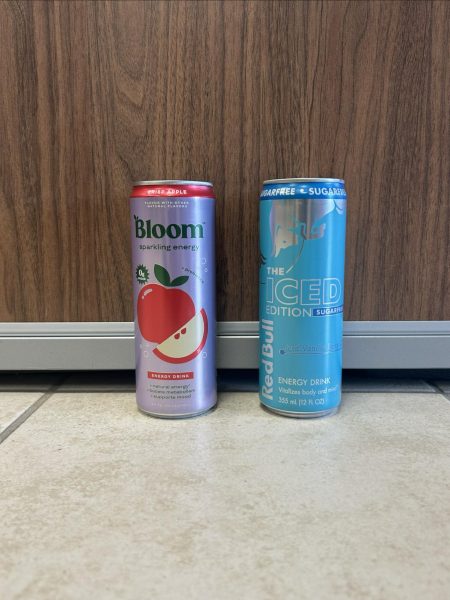
Although both Bloom and Red Bull are energy drinks, they have very different nutrition facts that set them apart from each other. The Bloom (12 fl oz) has 180 mg of natural caffeine derived from a green coffee bean extract. Each also has 10 calories and contains 0 g of sugar. For the smaller cans (7.5 fl oz), they contain 100 mg of caffeine and 5 calories. Red Bull (12 fl oz) contains 80 mg of caffeine, about the same as a cup of coffee, and 114 calories (derived from 27 g of sugars). The small cans of Red Bull (8.4 fl oz) contain 80 mg of caffeine and 110 calories. Bloom has fewer calories and sugar but a lot more caffeine, while Red Bull is the opposite. The University of Michigan Medicine suggests that the appropriate amount of caffeine for a teenager to intake is no more than 100 mg per day, which is roughly equivalent to one 8-ounce cup of brewed coffee; more than that is not good for your body.
Coming from a high school 10th-grade student who wakes up at 5 o’clock every morning, I always have an energy drink in my hand. Knowing that it is bad for my health, I only have one energy drink every day rather than having 2-3 energy drinks per day like some of my friends. If I am tired, I will end up having a Bubbl’r that has less caffeine than a typical energy drink, while still having a satisfying flavor.